About Bali Salt Sea — Preserving Amed’s 450-Year Salt Heritage
Bali Salt Sea represents a unique convergence of heritage, sustainability, and global premium excellence. Since 1578, our family has cultivated the ancient art of sea salt farming in the pristine coastal waters of Amed, East Bali. Today, we continue this 450-year tradition while building a global brand that connects the world’s most discerning culinary professionals with authentic, heritage-produced artisan sea salt. We are bali sea salt company—not a factory, but a family legacy committed to preserving traditional methods while achieving international recognition through geographic indication protection and European Union certification.
Our Founding Story: From Royal Salt to Global Premium Brand
The Bali Salt Sea story begins in 1578 when our ancestors discovered that Amed’s unique coastal waters—enriched by volcanic minerals and blessed by perfect climate conditions—produced salt of exceptional quality. This discovery led to salt production for the royal court of the King of Karangasem, establishing our family as the premier salt makers of East Bali. For four and a half centuries, this tradition has passed unbroken from father to son, mother to daughter, each generation refining techniques and deepening their understanding of this ancient craft.
In 2015, the Indonesian government awarded us Geographical Indication (GI) Protection, recognizing Amed’s salt as a unique protected product. In 2022, we achieved European Protected Designation of Origin (EU PDO) certification—placing Bali Salt Sea alongside the world’s most prestigious foods including Parmigiano-Reggiano, Champagne, and Prosciutto di Parma. These certifications validate what our family has known for centuries: Amed’s salt cannot be authentically replicated anywhere else on Earth. Today, Bali Salt Sea represents the bridge between our heritage and the global market, connecting Amed’s traditional salt farmers with premium restaurants, gourmet retailers, and home cooks worldwide who understand that true quality is irreplaceable.
Our Mission: Authenticity, Sustainability, and Community Excellence
Bali Salt Sea’s mission is threefold. First, we are devoted to preserving the authentic traditional methods developed over 450 years—the palungan technique, the seasonal rhythms, the hand-harvesting approach that transforms salt production from industrial process into artisanal craft. Second, we are committed to sustainability: our annual production of just 15-20 tons of regular salt and 200-300 kg of fleur de sel ensures we never compromise environmental stewardship for profit. Third, we prioritize community benefit—our hand-harvesting approach provides meaningful livelihoods for 50+ salt farming families in Amed, ensuring that salt production remains an economically viable career path for the next generation.
We believe that heritage brands can only thrive when they genuinely benefit the communities that created them. Bali Salt Sea represents this principle in practice: premium pricing reflects fair wages, safe working conditions, and long-term employment stability for our team. The Juara Holding Group ecosystem—encompassing luxury tourism, media, and real estate investments—creates multiple revenue streams that allow us to operate Bali Salt Sea with integrity rather than desperation, prioritizing quality and sustainability even when production could be increased for greater profit.
Company Values: Authenticity, Sustainability, Community, Excellence
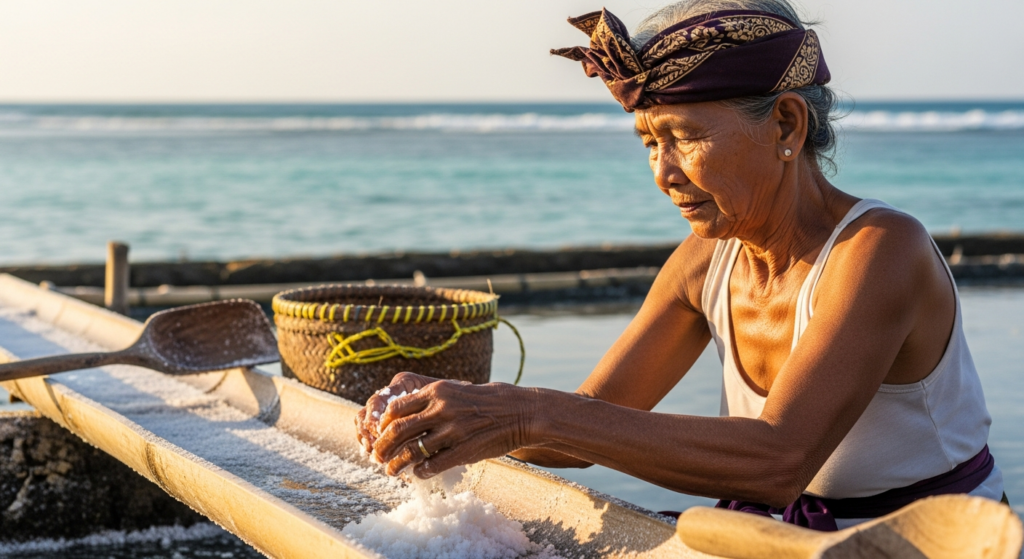
Authenticity: Everything we do honors the traditional methods developed over 450 years. We use no industrial additives, no mechanical processing, no shortcuts. The palungan technique—ancient coconut trunk salt pans—remains central to our process. We maintain complete traceability: every kilogram of Bali Salt Sea can be traced to its specific harvest date and salt pan.
Sustainability: Limited production is not a constraint but a defining value. By harvesting just 15-20 tons annually, we protect Amed’s marine ecosystem, provide ecosystem regeneration time, and ensure that salt production remains compatible with ocean health. Our zero-chemical approach, solar-powered evaporation, and minimal waste production create the lowest environmental impact possible.
Community: Our salt farming families are not vendors but partners. We maintain wages well above regional standards, provide employment security, and invest in training for the next generation. Our partnership with the broader Juara Holding Group ecosystem creates opportunities beyond salt farming—tourism experiences, retail employment, and business development possibilities that strengthen local economic resilience.
Excellence: Premium quality is non-negotiable. We reject approximately 20-30% of harvested salt that doesn’t meet our standards. Our GI and PDO certifications require independent verification and regular audits. We invest continuously in quality assurance, mineral analysis, and batch-to-batch consistency verification because excellence is the foundation of our brand reputation and the reason customers worldwide choose Bali Salt Sea.
Leadership & Vision: Agung Afif and Juara Holding Group
Bali Salt Sea is led by Agung Afif, founder of Juara Holding Group, an entrepreneur dedicated to preserving Bali’s cultural heritage while building globally competitive premium brands. Agung’s vision recognizes that heritage assets like Amed’s salt farming tradition represent untapped value when properly positioned in global markets. Rather than extracting maximum profit through scaling, Agung invests in building authentic brands that benefit heritage communities while achieving international recognition.
The Juara Holding Group ecosystem provides Bali Salt Sea with strategic advantages: luxury tourism partnerships create brand awareness and direct-to-consumer sales opportunities; media investments build authentic brand storytelling; real estate developments in premium tourism destinations create hospitality partnerships. This integrated approach allows Bali Salt Sea to operate with integrity and long-term perspective rather than quarterly profit pressure.
Timeline: From Royal Salt to Global Premium Brand
1578: Salt production begins in Amed for the royal court of the King of Karangasem. Traditional methods using palungan coconut trunk pans are established.
2015: Indonesian government awards Geographical Indication (GI) Protection to Amed salt, officially recognizing its unique characteristics and geographic specificity. Registration Number: ID G 000000038 (December 23, 2015).
2022: European Union awards Protected Designation of Origin (PDO) certification, placing Bali Salt Sea alongside Europe’s most prestigious protected products. Registration Number: PDO-ID-02610 (October 14, 2022).
2024: Bali Salt Sea brand launches globally, creating direct access to international markets while maintaining traditional production in Amed. Partnerships with premium restaurants, gourmet retailers, and spa/wellness centers begin.
Team & Organization
Our leadership team combines heritage expertise with contemporary business vision. Production is led from inside the salt-farming families themselves, several of them third- and fourth-generation Amed artisans. Our export desk oversees international logistics and quality assurance, and our operations side manages the relationships with more than fifty salt-farming families along the coast. Our Quality Control expert ensures every batch meets GI and PDO standards. This blend of traditional knowledge and professional management allows us to honor heritage while meeting global standards.
Learn more about our 450-year heritage story, explore how we make salt, or discover our certifications and standards. Visit our salt farm tour experience or contact us for wholesale partnerships and inquiries.
Explore More from Bali Salt Sea
our products • our heritage • salt making • our team • sustainability • contact us