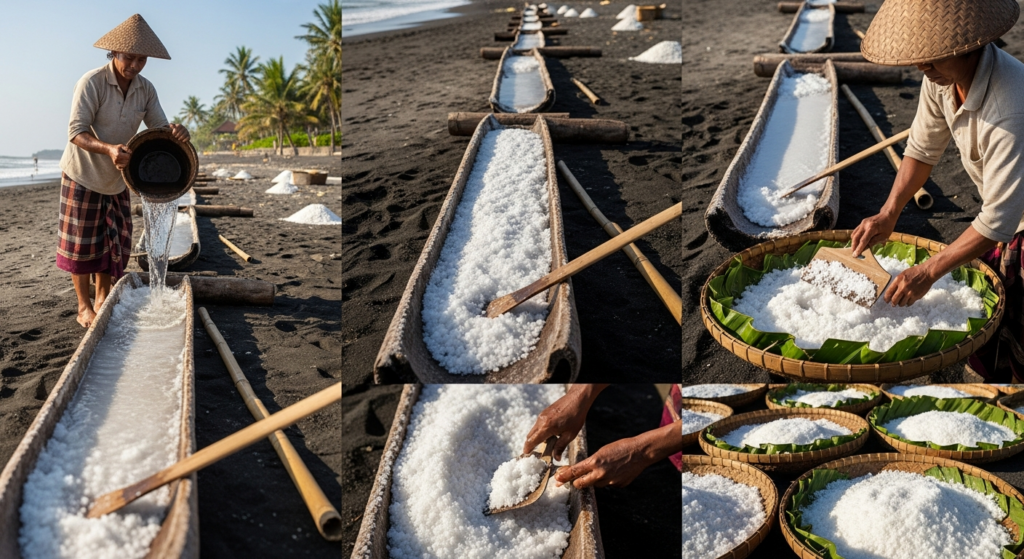
How Bali Sea Salt is Made — Traditional Hand-Harvesting in Amed
How is bali sea salt made? The answer spans seven distinct stages, each requiring expertise developed across generations. Unlike industrial salt production—which takes days using mechanical evaporation and chemical processing—our traditional hand-harvesting method requires 6-7 weeks per batch. This extended timeline allows nature and human skill to create salt with complexity and character that rapid mechanical processes cannot produce. Every crystal in Bali Salt Sea carries the work of our artisan salt makers and the unique characteristics of Amed’s pristine seawater.
Stage 1: Pre-Dawn Seawater Collection from Pristine Amed Coast
Our salt-making process begins before sunrise, when our salt makers wade into the calm waters off Amed’s coast. Water selection happens at dawn because ocean conditions—temperature, mineral concentration, wave action—are most favorable at this time. Our team collects water from pristine depths, avoiding surface layers and ensuring maximum mineral concentration. The water’s initial mineral content directly influences the final salt’s character, so careful source selection is essential.
This step cannot be mechanized. Experienced salt makers understand intuitively which water conditions produce optimal results. They observe tide patterns, check temperature, assess mineral concentration through tasting and observation. This embodied knowledge—developed through years of daily interaction with Amed’s waters—is what distinguishes heritage salt farming from industrial approaches.
Stage 2: Sand Bed Filtration for Impurities
Collected seawater is transferred to traditional sand bed filters where preliminary sediment and impurities separate naturally. This gentle filtration preserves mineral content while removing larger particles and organic matter. The sand beds themselves are carefully maintained—the sand is periodically cleaned and replaced to ensure filtration effectiveness. This stage requires constant attention and understanding of how water flows through sand under various conditions.
Where industrial salt production uses chemical clarification (which removes trace minerals and alters flavor), our sand filtration preserves the complete mineral spectrum. The process is slower but produces purer, more flavorful salt.
Stage 3: Brine Concentration Using Sun and Natural Evaporation
Filtered seawater is transferred to the first series of palungan (coconut trunk salt pans) where natural solar evaporation concentrates the brine. This stage lasts 2-3 weeks depending on weather conditions. Our salt makers monitor water levels obsessively—checking pH, observing evaporation rates, adjusting pan positioning as needed. The goal is to concentrate minerals without beginning crystallization, creating increasingly saline water that will eventually produce superior salt crystals.
This stage cannot be accelerated. Industrial producers use heated evaporation to speed this process, but heat damages delicate mineral compounds and flavor characteristics. We work with seasonal rhythms and natural sun intensity, accepting longer timelines as the price of superior quality.
Stage 4: Transfer to Palungan Carved Coconut Trunks
As brine reaches optimal mineral concentration, it transfers to specialized palungan salt pans—carved coconut tree trunks that have been used for this purpose for centuries. These natural pans possess unique properties: their porosity allows slow water seepage that promotes crystallization, their thermal characteristics create ideal temperature gradients, their size and shape concentrate mineral-rich water optimally. Each palungan is hand-carved and represents a significant investment—a single pan lasts 15-20 years before naturally biodegrading and requiring replacement.
The choice to continue using palungan despite modern alternatives reflects our commitment to traditional methods. Concrete or plastic pans would be cheaper and more durable, but they lack the acoustic and thermal properties that make palungan ideal for our process. We maintain this traditional approach because it produces superior salt, not despite its apparent inefficiency.
Stage 5: Solar Crystallization Over Days
In palungan, highly concentrated brine undergoes slow crystallization over 3-5 days. This extended timeline is essential—rapid crystallization produces inferior crystals, while slow crystallization allows mineral compounds to arrange optimally. Our salt makers observe daily as crystals form, monitoring temperature, humidity, and water conditions. They understand through experience precisely when crystallization has reached ideal stages for each harvest type.
Fleur de sel (the rarest “flower of salt”) forms only under specific atmospheric conditions—warm, low humidity, gentle breeze. This crystals forms on the surface and requires immediate hand-harvesting. Coarse salt forms at the bottom. Fine salt develops throughout the pan. A single experienced salt maker can read these conditions and judge exactly when to harvest each variety.
Stage 6: Hand-Harvesting with Fleur de Sel Skimming and Coarse Collection
Hand-harvesting represents the heart of our craft. Fleur de sel—the delicate surface crystals forming like flowers—is skimmed gently using traditional wooden tools. This must happen at the exact moment of optimal crystal development. A few hours too early, and crystals won’t have fully formed. Too late, and they break or lose their characteristic structure. This judgment requires years of experience.
Coarse salt crystallizing at the bottom is raked slowly, allowing salt makers to inspect each handful and reject inferior or contaminated crystals. Approximately 20-30% of harvested salt is rejected during this process because it fails to meet our standards. This quality control happens through human judgment, not laboratory testing. Experienced salt makers instantly recognize which crystals meet our exacting specifications.
Fine salt crystals are collected separately, offering different flavor and mouthfeel characteristics. All varieties come from the same water and process—the distinction is timing and crystal development stage.
Stage 7: Grading, Sorting, and Packaging
Harvested salt is spread on clean surfaces for final air-drying in Bali’s tropical sun. This natural drying, lasting 5-7 days, completes the crystallization process gently. Salt is then hand-sorted—further grading by size, color, and texture. Only the finest crystals proceed to our premium packaging. All salt is immediately sealed in airtight containers to protect mineral content and prevent moisture absorption.
Packaging materials are chosen carefully. Glass jars preserve salt quality indefinitely and align with our sustainability values. Labeling includes harvest date, variety, and traceability information. Every package of Bali Salt Sea can be traced to the specific harvest, palungan, and date it was produced.
Seasonal Variations: April-October Peak Harvest Season
Our salt-making process follows Bali’s dry season (April-October) when atmospheric conditions optimize crystallization. Peak activity occurs during May-August when consistent sun, low humidity, and gentle breezes create ideal conditions. We occasionally harvest during transitional months when conditions permit, but winter months (November-March) with higher humidity and cloud cover dramatically reduce crystallization quality. This seasonal rhythm is non-negotiable—attempting to force production during unfavorable seasons produces inferior salt.
This seasonal limitation contributes to our scarcity and premium positioning. We cannot simply ramp up production to meet demand—we’re constrained by nature’s calendar. This constraint forces quality excellence because we have no alternative strategy.
Discover our environmental commitment, learn about our quality standards, or book a farm tour to observe our process firsthand. Explore our 450-year heritage or contact us for wholesale inquiries.
Explore More from Bali Salt Sea
our heritage • visit our salt farm • Fleur de Sel • sustainability • about Bali Salt Sea