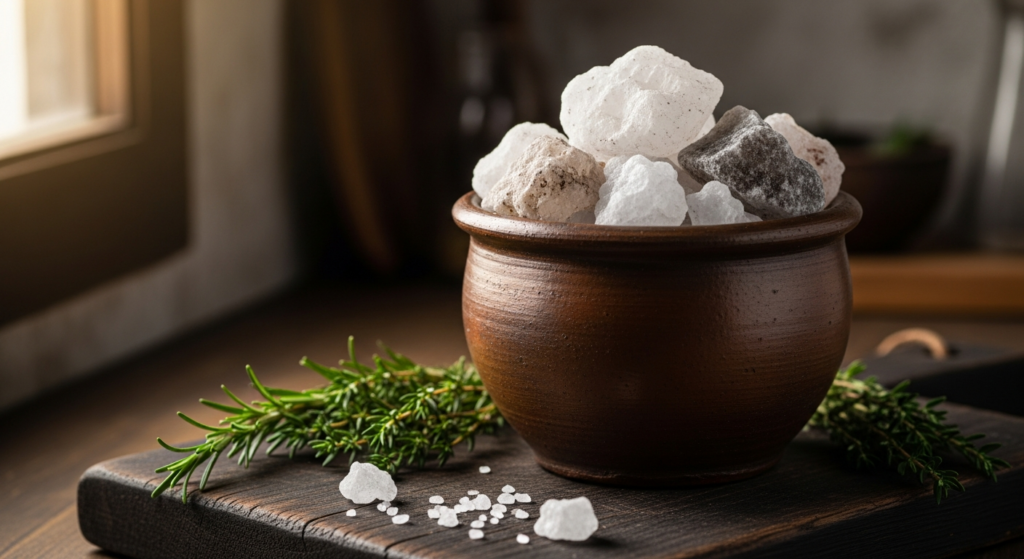
Bali Coarse Sea Salt — Traditional Hand-Harvested from Amed’s Pristine Waters
Bali coarse sea salt represents the everyday expression of our heritage. While our fleur de sel commands attention through extraordinary rarity, our coarse sea salt delivers the core of what makes Bali Sea Salt exceptional: traditional hand-harvesting using the palungan method, mineral-rich volcanic seawater, and centuries of salt-making expertise. At $25–45 per 500g, coarse sea salt from Amed is the most versatile product in our collection—equally at home finishing a steak, brining a brisket, or seasoning everyday kitchen staples. This is the salt that professional chefs choose when they want superior quality without astronomical pricing.
What Makes This Coarse Sea Salt Special
Hand-harvested sea salt from Amed differs fundamentally from industrial alternatives. Here’s why our coarse sea salt earns loyalty from chefs and home cooks worldwide:
Hand-Harvested Using Palungan Technique
The palungan—a specifically selected coconut trunk with carved grooves—is the centerpiece of our harvesting method. Our salt makers gently scrape crystallized salt from pan surfaces without disturbing the floor, preserving crystal integrity. This technique cannot be mechanized. Industrial producers harvest with shovels and machinery that shatter crystals, reducing quality and creating dust. Our approach produces intact, beautiful crystals.
Volcanic Mineral Profile
East Bali’s volcanic seabed creates mineral-rich water unique to our region. Independent testing confirms 84 trace minerals in our coarse sea salt—compared to 12–15 in industrially produced salts. These minerals enhance flavor and provide subtle complexity that transforms everyday cooking into something special.
Natural Crystallization Process
Our coarse sea salt develops through months of patient solar evaporation across interconnected salt pans. This slow process allows minerals to distribute evenly and flavor complexity to develop. Industrial salt uses artificial heat and chemical additives to accelerate crystallization in hours or days, degrading both flavor and mineral integrity.
Chemical-Free Processing
No additives. No anti-caking agents. No bleaching. Just seawater, sun, and salt makers’ expertise. Our final product is 100% pure salt—nothing else added, nothing removed except moisture.
GI & PDO Certification
Our coarse sea salt carries official certifications that guarantee authenticity: Indonesia Geographical Indication (2015) and EU Protected Designation of Origin (2022). These certifications mean this salt can only be labeled as authentic production from Amed if it meets strict criteria verified by independent authorities.
Mineral Profile & Health Benefits
Coarse sea salt from Amed contains a complete spectrum of trace minerals derived from volcanic seawater. This mineral profile distinguishes our product from refined table salt and even from commodity sea salts:
- Sodium Chloride (NaCl): 95–97% — The primary mineral that provides saltiness
- Magnesium: ~1.2% — Essential for muscle and nerve function
- Calcium: ~0.4% — Supports bone health and cellular function
- Potassium: ~0.2% — Critical for electrolyte balance and heart rhythm
- Trace minerals: 80+ additional elements in minute quantities including iodine, zinc, iron, manganese, and copper
Industrial table salt is often stripped of minerals through refining, then has iodine added back in tiny amounts. Our coarse sea salt retains the complete mineral profile that nature created, providing bioavailable minerals your body recognizes and utilizes. Some health professionals argue that mineral-rich sea salt offers superior nutritional value compared to refined salts, though we recommend consulting healthcare providers about individual dietary needs.
The culinary benefit is immediate: mineral-forward saltiness enhances food flavor and creates more interesting taste profiles than pure NaCl alone.
Cooking Applications for Coarse Sea Salt
The versatility of bali coarse sea salt makes it suitable for nearly any culinary application:
Finishing Red Meat & Fish
Sprinkle coarse sea salt over steak, fish fillets, or roasted meats just before serving. The larger crystals create visible texture, mineral flavor enhances umami, and the crunch provides sensory interest. Professional chefs finish nearly every protein with sea salt.
Seasoning Soups & Sauces
Coarse sea salt dissolves readily in hot liquids. Use it to season soup broths, pan sauces, and reduction-based preparations. The mineral profile brightens flavors that slow-cooking might mute.
Salting Pasta Water
Traditional technique calls for heavily salted pasta cooking water. Use coarse sea salt—the larger crystals allow better control of salt concentration. This creates properly seasoned pasta that tastes excellent before sauce is even added.
Brining & Curing
Coarse sea salt is ideal for brining chicken, pork, or fish before cooking. The larger crystals dissolve slower, allowing even salt distribution. Use 5–7% salt by weight for brining (5–7g salt per 100ml water).
Bread & Pastry Making
Bakers use sea salt to enhance gluten development and flavor in bread doughs. Use sparingly—approximately 2% of flour weight. Coarse crystals add textural interest to focaccia and rustic breads.
Vegetable Seasoning
Roasted vegetables, salads, and fresh preparations benefit from coarse sea salt’s mineral brightness. The crystals dissolve during roasting while imparting superior flavor.
Popcorn & Snacks
Coarse sea salt sticks to popcorn and snacks better than fine salt. The mineral profile transforms simple snacks into more interesting flavor experiences.
Bali Coarse Sea Salt vs Himalayan Pink Salt
Himalayan pink salt is heavily marketed, but coarse sea salt from Amed offers different benefits worth understanding:
| Characteristic | Bali Coarse Sea Salt | Himalayan Pink Salt |
|---|---|---|
| Origin | Volcanic seawater, Amed, Bali | Ancient marine deposit (200+ million years old) |
| Mineral Content | 84 trace minerals in bioavailable form | 84 trace minerals in crystalline form |
| Flavor Profile | Bright, mineral-forward, subtle sweetness | Milder saltiness, slight mineral undertones |
| Culinary Application | Superior for finishing, seasoning, cooking | Good for salt blocks, decorative presentation |
| Sustainability | Renewable (harvested annually from ocean) | Non-renewable (ancient deposits) |
| Production Method | Hand-harvested traditional technique | Mined from crystalline deposits |
| Environmental Impact | Minimal—no chemicals, zero waste | Moderate—mining impacts local geology |
Both are superior to refined table salt. Choose coarse sea salt from Amed if you prioritize flavor, renewable sourcing, and traditional hand-harvesting. Himalayan salt is visually stunning for salt blocks and decorative applications.
Package Sizes & Recommended Use
- 250g Glass Jar: $14–18 — Perfect for home cooks trying the product. Lasts 2–3 months in typical household use.
- 500g Glass Jar: $25–35 — Most popular size. Ideal for home kitchens and small restaurants. Lasts 3–6 months with regular use.
- 1kg Bulk Container: $45–65 — For serious home cooks and professional kitchens. Economical pricing for volume.
- Bulk Wholesale: Custom quantities and pricing available. Contact us for restaurant, retail, or large-volume orders.
Frequently Asked Questions
What’s the difference between coarse sea salt and fine sea salt?
Coarse sea salt has larger crystals (2–4mm), while fine sea salt has smaller crystals (0.5–1.5mm). Coarse salt is better for finishing dishes where you want visible crystals and textural crunch. Fine salt dissolves faster and is better for cooking applications, baking, and recipes where you don’t want to see salt crystals. Both come from the same source—Amed’s volcanic seawater—and are harvested using the same palungan method. The crystal size difference comes from the final sorting process. Choose coarse for finishing dishes where appearance matters; choose fine for cooking where salt needs to dissolve completely.
Is this coarse sea salt iodized?
No. Our coarse sea salt contains naturally occurring iodine from the seawater—approximately 100–200 mcg per gram. This natural iodine is not added; it’s present because our salt source is seawater. Some people worry about iodine deficiency when avoiding table salt, but sea salt typically contains adequate natural iodine. However, iodine content can vary based on seawater source and processing. If you require specific iodine levels for medical reasons, consult your healthcare provider. Our salt is tested for mineral content and we provide analysis on request.
Can I use coarse sea salt in a salt grinder, or should I keep it whole?
Coarse sea salt can go through a salt grinder if you prefer ground salt for certain applications. However, we recommend keeping coarse salt whole when possible. The larger crystals allow better control of salt quantity, and the visual presentation of intact crystals is part of the appeal for finishing applications. If you grind coarse salt, you lose some of the textural interest and visual distinction that make hand-harvested salt special. Consider using our fine sea salt for applications where pre-ground salt is preferred.
How much coarse sea salt should I use compared to table salt?
Coarse sea salt is approximately 3% heavier than table salt due to larger crystal size and higher mineral content. For equivalent saltiness, use slightly less coarse sea salt than table salt. As a general rule: if a recipe calls for 1 tablespoon of table salt, use approximately 0.9–0.95 tablespoons of coarse sea salt. Most home cooks simply add coarse sea salt to taste rather than measuring precisely—this is the traditional approach and often yields better results than strict measurements. Start with less, taste, and adjust upward as needed.
Is coarse sea salt from Amed more expensive than other sea salts?
Yes, but pricing reflects the production reality. Hand-harvested sea salt from Amed costs more than industrially produced sea salt because every stage involves labor, tradition, and uncompromised quality. Industrial producers mechanize, use chemical additives, and accept lower quality to reduce costs. We refuse these shortcuts. At $25–45 per 500g, coarse sea salt from Amed remains affordable compared to specialty food products while delivering genuinely superior quality. The mineral profile, flavor, and hand-harvested heritage justify premium pricing. You’re not paying for a label—you’re paying for authentic excellence.
Order Bali Coarse Sea Salt
Experience the difference that traditional hand-harvesting and volcanic minerals create. Perfect for everyday cooking and professional kitchens.
EU PDO Certified 2022
Hand-Harvested
Since 1578
Explore More from Bali Salt Sea
our collection • Fine Sea Salt • Smoked Sea Salt • how we make our salt • wholesale orders • get in touch