Frequently Asked Questions About Bali Sea Salt
This comprehensive FAQ addresses common questions about Bali Salt Sea products, ordering, shipping, wholesale opportunities, quality standards, certifications, health considerations, tourism experiences, and heritage information. If your question isn’t answered here, please contact us at info@balisaltsea.com.
Products & Varieties
What are the different salt varieties you offer?
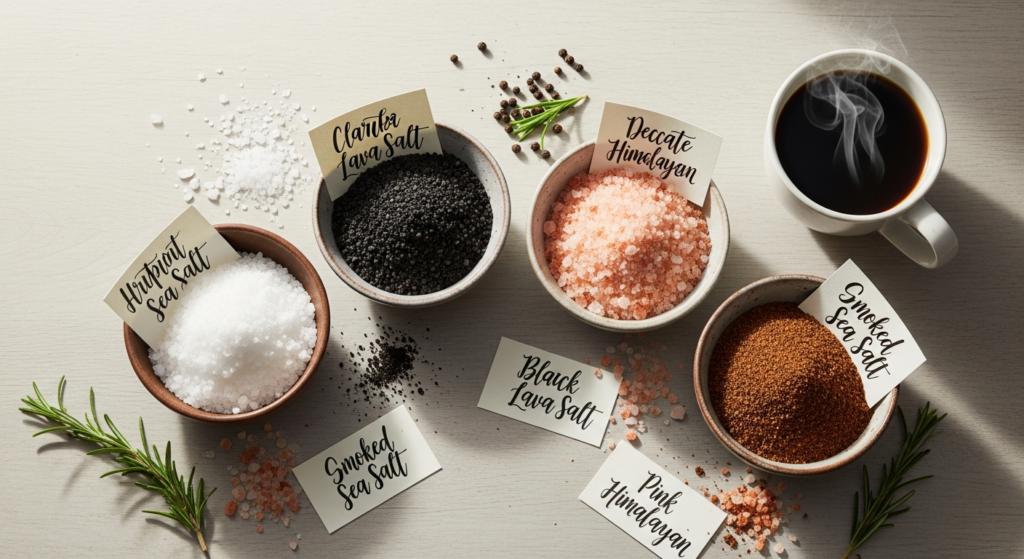
Bali Salt Sea produces three primary varieties. Fleur de sel (200-300 kg annually) is our ultra-premium “flower of salt”—delicate surface crystals forming under specific atmospheric conditions, commanding premium pricing due to scarcity. Fine sea salt offers delicate crystals ideal for finishing and precision seasoning, available year-round in scalable quantities. Coarse sea salt features large crystals perfect for salt mills and table use, offering premium appearance and sensory experience. All varieties come from the same pristine Amed seawater and contain identical mineral profiles—the distinction is crystal formation timing and size.
What makes Bali Salt Sea different from other sea salts?
Bali Salt Sea combines 450+ years of heritage with GI and PDO certifications, hand-harvesting, limited production (15-20 tons annually), solar evaporation, and 84 trace minerals. Our volcanic mineral composition creates distinctive flavor complexity. Each crystal is individually selected—we reject 20-30% of harvested salt maintaining quality standards. Most sea salts are industrially processed; ours is authentically artisanal.
How should I store Bali Salt Sea?
Store in cool, dry locations away from direct sunlight in airtight containers. Glass jars with tight-fitting lids are ideal. Sea salt without anti-caking agents naturally absorbs moisture—if clumping occurs, break apart with a fork. Properly stored salt maintains peak flavor and mineral integrity indefinitely. Many chefs maintain salt collections like spice collections, with different varieties serving different purposes.
Ordering & Purchasing
How do I order Bali Salt Sea products?
Contact sales@balisaltsea.com or WhatsApp +62-XXX with desired salt varieties and quantities. We’ll provide pricing based on product type, package size, and order volume, confirm availability, and arrange shipping with tracking information. Typical lead time for in-stock products is 5-10 business days. Custom packaging or large wholesale orders require 4-6 weeks production time.
What is the minimum order quantity?
For direct-to-consumer purchases, there is no formal minimum—we accommodate individual unit orders. For wholesale partners and private label programs, minimum order is 100kg. Volume orders (300kg+) receive 10-15% discounts; 1000kg+ orders receive 20-25% discounts.
What payment methods do you accept?
We accept bank transfers, credit cards, and alternative payment methods depending on order size and customer location. Detailed payment information is provided with purchase quotes. Large wholesale orders may negotiate payment terms (typically 50% deposit, 50% upon shipment).
Do you offer sample orders?
Yes. We can provide small sample quantities (50-100g) for product evaluation at minimal cost. Wholesale partners receive complimentary samples for customer testing. Contact sales@balisaltsea.com to request samples.
Shipping & Delivery
Do you ship internationally?
Yes. We ship worldwide via express logistics partners. International shipping is available to most countries, though some regions may have import restrictions. Contact sales@balisaltsea.com for availability in your specific location and shipping cost estimation.
How long does shipping take?
Domestic Indonesian shipping: 3-5 business days. International shipping: typically 7-14 business days depending on destination. Expedited shipping options are available for additional cost. All shipments include tracking information.
What are shipping costs?
Shipping costs vary based on package weight, destination, and carrier selection. Costs are calculated based on actual shipping rates and provided with purchase quotes. Orders over 1kg typically qualify for consolidated shipping reducing per-unit costs.
Are orders insured in transit?
All international shipments include basic insurance. Enhanced insurance is available for high-value orders. Insurance details are provided with shipping confirmation.
Quality & Certifications
What certifications does Bali Salt Sea hold?
Bali Salt Sea holds Indonesian Geographical Indication (GI) Protection since 2015 and European Protected Designation of Origin (PDO) certification since 2022. These certifications verify our authentic origin, traditional methods, quality standards, and sustainability practices. All certifications are independently verified and regularly audited.
Is Bali Salt Sea organic certified?
Bali Salt Sea is produced entirely without additives, chemicals, or synthetic processing—qualifying as naturally organic. Our GI and PDO certifications verify our production standards. If specific organic certification documentation is required for your market, we can discuss certification pathways.
Is Bali Salt Sea Halal certified?
Bali Salt Sea contains no animal products or prohibited additives, making it Halal-compliant by nature. We can provide formal Halal certification documentation if required for specific markets.
How is Bali Salt Sea tested for quality?
We conduct regular mineral content analysis, purity testing, crystal quality inspection, and batch-to-batch consistency verification. All salt exceeds food safety standards and is tested for contaminants and heavy metals. Every package includes batch identification enabling complete traceability to specific salt ponds and production dates.
What is the mineral content of Bali Salt Sea?
Bali Salt Sea naturally contains 84 trace minerals including magnesium, calcium, potassium, iron, zinc, and many others. Industrial sea salts typically contain 12-15 minerals. This mineral richness creates our distinctive flavor profile and nutritional value.
Health & Usage
Can everyone use Bali Salt Sea?
Bali Salt Sea is a culinary salt suitable for most people. If you have specific health conditions (hypertension, kidney disease, dietary restrictions), consult healthcare providers regarding salt consumption. Our salt is pure sea salt without additives, making it suitable for various dietary approaches.
Is Bali Salt Sea suitable for all cooking methods?
Yes. Bali Salt Sea works for all culinary applications—finishing dishes, seasoning during cooking, baking, brining, salt crusts. Fine salt blends smoothly into recipes; coarse salt works beautifully in mills or for garnishing. The mineral-rich composition enhances flavor in every application.
How much Bali Salt Sea should I use compared to table salt?
Bali Salt Sea’s mineral content creates more intense flavor than refined table salt. Start with slightly less than you’d use with table salt (approximately 80-90% of the quantity), then adjust to taste. The mineral complexity means less salt often creates more satisfying seasoning.
Can I use Bali Salt Sea for pickling and preservation?
Absolutely. Our salt’s pure mineral composition without additives makes it ideal for brining, pickling, and fermentation. Use at 5-10% by weight for vegetable preservation. The clean mineral profile ensures successful fermentation and preserves vegetable flavor.
Tourism & Farm Visits
When are salt farm tours available?
Tours are available April-October dry season when crystallization and harvesting are most active. Peak season is May-August with consistent weather and active production. Winter months have reduced harvesting activity. Advance booking of 2-4 weeks is recommended.
How long do salt farm tours last?
Tours typically last 2-3 hours depending on group size and questions. Duration includes heritage introduction, observation of active harvesting, meeting salt makers, learning traditional techniques, and comprehensive salt tasting.
What should I bring to the salt farm tour?
Bring sun protection (hat, sunscreen), water, comfortable walking shoes, and camera for photography. Salt pond areas involve walking on uneven ground and standing for extended periods. Generally suitable for ages 8-80 depending on physical ability.
Can I arrange a group tour?
Yes. We accommodate individual visitors, families, and small groups (2-10 people ideal). Larger corporate groups can be arranged with advance notice. Contact tours@balisaltsea.com to discuss your group’s size and interests.
Can I participate in actual salt harvesting?
If conditions permit and you’re interested, our salt makers will guide you in gentle hands-on harvesting. This gives you direct experience of the skill and patience required for proper salt crystal selection.
Wholesale & Partnership
How do I become a wholesale partner?
Contact our B2B team at sales@balisaltsea.com or export@balisaltsea.com with information about your business, customer base, and partnership interest. We evaluate opportunities ensuring alignment with our values. Product samples are provided for evaluation and customer testing. Partnership agreements clarify pricing, volumes, and support terms.
What wholesale pricing structures do you offer?
Pricing is based on product type, packaging complexity, and order volume. 100kg orders receive base pricing. 300kg+ receive 10-15% discounts. 1000kg+ receive 20-25% discounts plus customized packaging and logistics coordination. Detailed quotes provided upon request.
Can I develop private label products with Bali Salt Sea?
Yes. Private label services allow you to offer products featuring your branding with our salt. We provide production, custom packaging, label printing, and quality assurance. Minimum order is 100kg. Lead time is 4-6 weeks for custom packaging. Contact export@balisaltsea.com for private label details.
Heritage & History
How long has Bali salt been produced?
Salt has been produced in Amed continuously since 1578—450 years of unbroken heritage. Our family has maintained this tradition across all intervening centuries, passing knowledge and methods from generation to generation.
What is the palungan technique?
Palungan refers to traditional salt pans carved from coconut tree trunks. These natural pans provide ideal conditions for solar evaporation and salt crystallization. Coconut trunks last 15-20 years and naturally biodegrade, making this a sustainable, low-impact salt farming method.
Why does Bali Salt Sea only produce 15-20 tons annually?
This limited production reflects our commitment to sustainability and quality over quantity. Higher production would strain Amed’s marine ecosystem. Our constrained output forces excellence because we have no alternative—we cannot compromise quality to meet volume demand.
What makes Amed’s salt unique compared to other salt-producing regions?
Amed’s unique advantage is volcanic seawater enriched with 84 trace minerals from Mount Agung’s volcanic chain. This mineral composition, combined with specific climate conditions and our 450-year heritage of refined techniques, creates salt with characteristics unavailable elsewhere. This geographic specificity is the foundation of our GI and PDO certifications.
For additional questions, contact info@balisaltsea.com. Our team responds within 24 hours. Explore our full site to learn more about our company, our heritage, how we make salt, or our product varieties.
Explore More from Bali Salt Sea
our products • contact us • export information • wholesale details • certifications