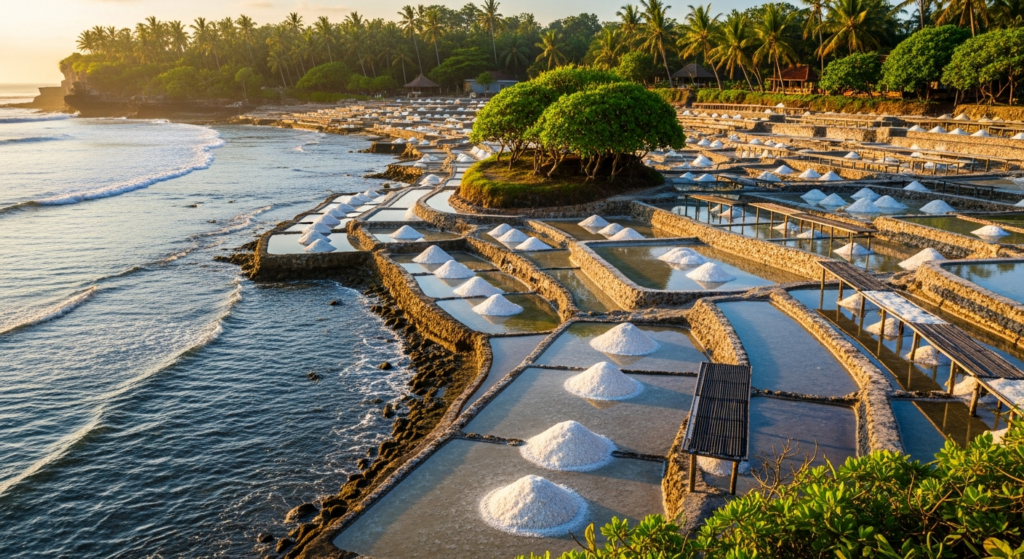
Sustainability — Zero-Waste, Solar-Powered Salt Production
Bali Salt Sea’s commitment to sustainability is not a marketing claim but a production reality embedded in every stage of our process. Sustainable salt production bali represents genuine environmental stewardship balancing premium quality with ecological responsibility. Our 450-year heritage taught us that long-term viability requires environmental protection—a lesson that contemporary industrial agriculture is still learning.
Solar Evaporation: Zero Energy Input, Zero Industrial Footprint
Our salt production relies entirely on solar evaporation. Seawater is placed in traditional palungan pans where Bali’s tropical sun provides the only energy input. There are no heated evaporation vessels, no mechanical equipment, no industrial facilities. This solar-powered approach eliminates the massive energy consumption that characterizes industrial salt mining and production.
Industrial salt operations—whether mining rock salt or mechanically processing seawater—consume enormous energy volumes. Heated crystallization occurs in industrial facilities running 24/7. Mechanical harvesting, processing, and packaging require equipment and electricity. Bali Salt Sea requires only sun and human skill, making our carbon footprint dramatically lower than industrial competitors.
This zero-energy approach is not a limitation we’re forced to tolerate—it’s a deliberate choice reflecting our values. We could accelerate production using heated evaporation, but this would compromise salt quality and environmental integrity. We maintain solar evaporation because it produces superior salt while minimizing environmental impact.
Palungan Coconut Trunk Reuse & Natural Biodegradation
Our salt pans are carved from coconut tree trunks—a natural, renewable resource. Each palungan lasts 15-20 years of continuous use before naturally biodegrading and requiring replacement. Coconut trunks represent sustainable resource use: they are abundant agricultural byproducts, they are renewable (new coconut trees continuously grow), and they naturally return to soil after their productive lifespan.
Industrial salt operations use concrete or plastic pans lasting 30-50 years. While longer-lasting might appear more sustainable, concrete production creates massive carbon emissions, and plastic represents petrochemical waste persisting for centuries. Our palungan approach—shorter lifespan but renewable materials—creates lower net environmental impact.
By using palungan made from local coconut trees, we support sustainable forestry practices and maintain connection between salt farming and Bali’s broader agricultural ecosystem. Coconut farming and salt farming are complementary economic activities supporting community resilience.
Zero Industrial Chemicals, Pure Natural Production
Bali Salt Sea uses no chemicals at any production stage. Industrial salt production employs caustic soda, hydrochloric acid, anti-caking agents, iodine additives, and other processing chemicals. These chemicals improve shelf stability and appearance but compromise purity and environmental safety. Chemical processing wastewater requires treatment before ocean discharge, creating additional environmental impact.
Our process involves only natural sun, sea, sand filtration, and human labor. No additives modify the final product. No chemicals contaminate production facilities. Production creates no hazardous waste requiring special disposal. This zero-chemical approach is simultaneously superior for salt quality and minimal for environmental impact.
Community Employment: Direct Livelihoods for 50+ Families
Our hand-harvesting approach requires skilled local labor, providing meaningful employment for 50+ salt farming families in Amed. These are not low-wage, seasonal positions—they are career livelihoods with fair wages exceeding regional standards, safe working conditions, and employment stability. Many team members represent multi-generational salt farming families maintaining this work because it provides respectable income and cultural continuation.
Sustainability extends beyond environmental protection to community resilience. By maintaining hand-harvesting, we ensure salt farming remains economically viable employment. We support local communities, reduce rural-to-urban migration pressure, and preserve traditional knowledge. A truly sustainable business model protects human livelihoods alongside environmental ecosystems.
Our wages are transparent—significantly above regional agricultural averages. Our working conditions are safe—no hazardous chemical exposure, appropriate sun protection, flexible scheduling respecting cultural practices. Our employment is stable—multi-year agreements rather than seasonal contracts. Supporting Bali Salt Sea means directly supporting the livelihoods of salt farming families.
Minimal Packaging: Sustainability Through Restraint
Our packaging emphasizes minimalism. We use glass jars for premium products—glass is infinitely recyclable without degradation. For bulk products, we minimize packaging materials and use recyclable containers. Labeling is essential (traceability, certifications) but unnecessary decorative packaging is eliminated. Our philosophy: packaging should protect product quality, not create waste.
We encourage customers to reuse containers. Many Bali Salt Sea customers maintain our jars for years—using them for home storage of other products. This creates secondary use extending container lifespan. Some customers report keeping distinctive jars as mementos of Amed’s heritage.
Carbon-neutral shipping is achieved through offset programs compensating for transportation emissions. We prioritize efficiency—consolidating orders to minimize shipment frequency reduces overall carbon impact.
Carbon Neutral Production & Comparison to Industrial Salt Mining
When carbon inputs are calculated comprehensively—including solar collection, manual labor (humans consume food creating carbon), transportation, and packaging—Bali Salt Sea production creates minimal carbon impact compared to industrial alternatives.
Industrial salt mining involves excavation equipment (diesel powered), processing facilities (fossil fuel energy), chemical processing (energy-intensive), and long-distance transportation from mining regions to markets. A comprehensive carbon analysis shows industrial salt producing 5-10kg of CO2 per ton of salt; Bali Salt Sea produces under 1kg of CO2 per ton. This dramatic difference reflects our solar power reliance and zero-chemical approach.
By purchasing Bali Salt Sea, you support salt production with the world’s lowest environmental impact. You encourage agricultural communities to maintain traditional sustainable practices. You demonstrate market demand for authentic, environmentally responsible food production.
Regular Environmental Monitoring & Verification
Our commitment to sustainability is verified through regular environmental monitoring. Water quality testing in Amed’s salt ponds confirms our production maintains healthy marine ecosystems. Environmental audits verify compliance with GI and PDO sustainability requirements. These are not internal assessments—independent environmental agencies conduct verification.
We continuously evaluate opportunities for further sustainability improvement. Recent innovations include composting for minimal waste, expanded community benefit programs, and partnerships with environmental organizations studying our impact.
Learn more about our heritage commitment, explore our traditional methods, discover our quality standards, or contact us to discuss sustainability commitments.
Explore More from Bali Salt Sea
about Bali Salt Sea • our heritage • certifications • traditional process • learn more